 Save
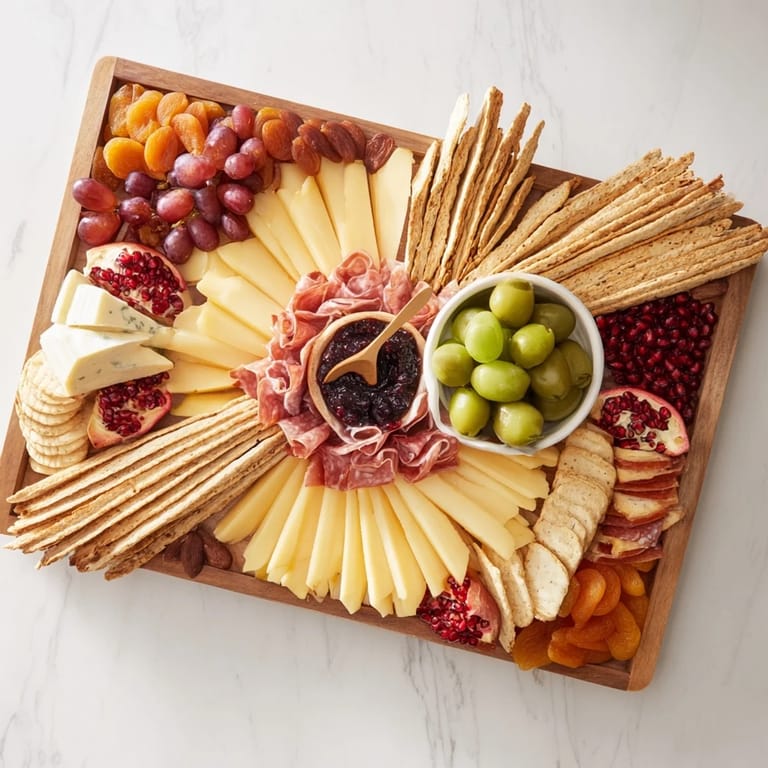
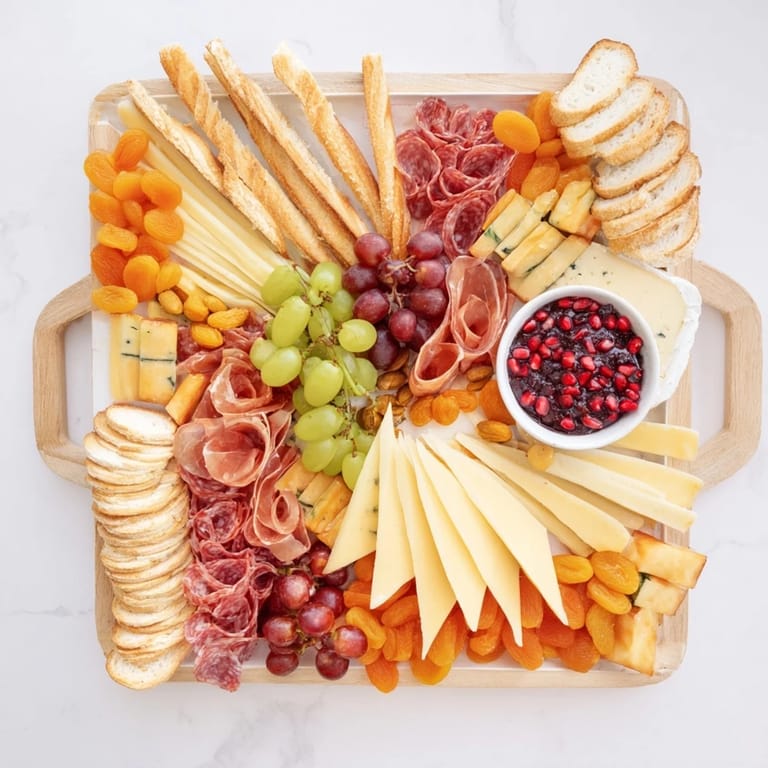
Save I'll never forget the first time I truly understood the power of presentation. A friend was hosting a dinner party, and instead of arranging a charcuterie board in the traditional scattered way, she created something that made guests literally gasp—every element pointed toward a central bowl like arrows converging on a target. The cheeses caught the light in geometric lines, the meats fanned outward with intention, and suddenly food became art. I watched people trace the board with their eyes before their hands, following an invisible path she'd created with nothing but intention and alignment. That night, I learned that when you arrange food with purpose, you're not just feeding people—you're inviting them into a moment.
I made this board for a small gathering last spring, and what started as a plating challenge became something unexpected. My sister, who normally eats around a board's edges picking randomly, found herself following the lines like a treasure hunt. She laughed and said she'd never eaten so intentionally before. That's when I realized: arrangement isn't vanity—it's an invitation to slow down and experience the food more deliberately. It completely changed how I think about hospitality.
Ingredients
- Aged cheddar, 120g (4 oz), cut into long thin triangles: The sharp, crystalline texture of aged cheddar holds its angular shape beautifully and provides a bold flavor anchor. Cut pieces about 2 inches long so they create clear, confident lines across the board.
- Manchego, 120g (4 oz), sliced into arrowhead shapes: This Spanish cheese is firm enough to cut into perfect arrow points without crumbling. Its buttery, slightly nutty flavor balances beautifully with stronger cheeses.
- Brie, 120g (4 oz), cut into slim wedges: Brie's creamy center and delicate rind make it the soft counterpoint to harder cheeses. Keep wedges narrow so the point of each piece is visible and contributes to the directional effect.
- Blue cheese, 120g (4 oz), broken into angular shards: Don't slice this one—break it into rough, jagged pieces. The irregular angles create visual texture while the bold, peppery flavor commands attention.
- Prosciutto, 100g (3.5 oz), torn into strips: The translucent, delicate nature of prosciutto makes it perfect for soft, flowing lines. Let pieces overlap slightly to suggest gentle movement toward your focal point.
- Hot coppa, 100g (3.5 oz), sliced on a bias: Bias cuts (about 45 degrees) elongate each slice, naturally pointing where you want them to go. The color and marbling of coppa create visual interest without overwhelming.
- Salami, 100g (3.5 oz), sliced diagonally: Similar principle to the coppa—diagonal cuts create natural directional lines. Choose a quality salami with good spice balance so flavors don't compete.
- Green grapes, 1 cup (150g), separated and trimmed to point toward the focal area: The round shape of grapes contrasts beautifully with all the angular elements. Trim stems short so nothing interferes with clean lines.
- Dried apricots, 1 cup (150g), sliced lengthwise: Golden apricots add color and natural sweetness. Cutting them lengthwise (rather than across) naturally creates pointed shapes that reinforce your directional theme.
- Pomegranate seeds, from 1 small pomegranate, scattered in a directional path: These jewel-like arils add pops of color and a tart burst of flavor. Use them sparingly to create lines, not puddles.
- Marcona almonds, 1/2 cup (60g), arranged in a narrow line: Marcona almonds are buttery and slightly sweet, unlike sharp regular almonds. Their oval shape naturally suggests directional movement.
- Castelvetrano olives, 1/2 cup (60g), aligned in a row: These green, buttery olives are milder than Kalamatas, so they won't overpower the board. Their uniform size makes them perfect for creating clean, precise lines.
- Fig jam or honey, 1/4 cup (60g), in the focal dip bowl: This is your visual and flavor destination. Choose fig jam for earthiness or honey for bright sweetness—either becomes the endpoint every arrow points toward.
- Seeded crackers, 1 cup (70g), stacked and fanned toward the focal point: Whole grain or seed crackers provide textural contrast to soft cheeses. Stack them so they fan naturally, like pages in a book opening toward your center.
- Baguette, 1/2, sliced on a diagonal, arranged in a V-shape: Diagonal cuts on bread are more elegant and naturally longer, perfect for creating your V-shape guide. Toast lightly beforehand if your gathering will be longer than an hour.
Tired of Takeout? 🥡
Get 10 meals you can make faster than delivery arrives. Seriously.
One email. No spam. Unsubscribe anytime.
Instructions
- Select and Prepare Your Board Surface:
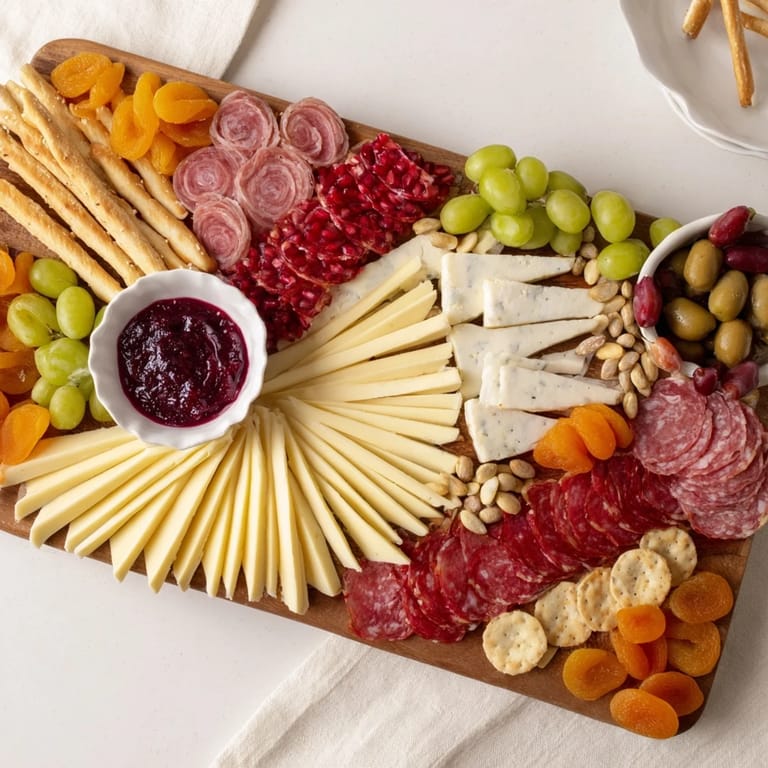
- Choose a large rectangular or oval wooden board at least 18 by 12 inches—the bigger the canvas, the more dramatic your directional effect becomes. Wipe it down with a damp cloth and dry it thoroughly; any moisture or residue will cause elements to slip and lose their alignment. Now comes the most important step: place your small dip bowl (ceramic or glass works best) at the endpoint where everything will converge. This isn't just a serving detail—it's the entire visual destination your guests' eyes will naturally follow. Everything else you arrange will point here.
- Cut Cheeses with Intention:
- This is where precision matters most. Your cheddar and Manchego should be cut into triangles and arrowhead shapes roughly 2 inches long—long enough to clearly point, short enough to eat in one bite. The brie wedges need to be slim but sturdy, with a visible point at the tip. For the blue cheese, resist the urge to cut neatly—break it into angular shards with your hands or knife. The irregular edges actually look more intentional and contemporary. Stand back after each piece and ask yourself: does this have a clear point or direction? If it's vague, recut it. Uniform, directional shapes are the entire visual language of this board.
- Arrange Cheeses in Radiating Lines:
- Imagine invisible arrows all pointing toward your center bowl. Start with your most visually striking cheese—typically the aged cheddar—and lay pieces in a line or chevron formation, all angles converging toward that dip bowl. Follow with Manchego, then brie, then blue cheese. Each cheese gets its own pathway, its own radiating line. The beauty comes from the contrast—hard against soft, sharp against mild, different colors and textures all moving in the same direction. Step back frequently; you're building a composition here, not just placing ingredients.
- Fold and Flow with Meats:
- Prosciutto should be folded loosely into ribbons, almost carelessly elegant, then angled toward your focal point. For coppa and salami, overlap the diagonal slices slightly, creating a gentle flow like water moving toward a destination. The key is momentum—nothing should look random or scattered. If a slice of meat looks greasy, pat it gently with a paper towel. You want the lusciousness of cured meat visible, not sliding around on the board.
- Layer Accompaniments with Restraint:
- Now add your grapes, apricots, pomegranate seeds, almonds, and olives. This is where many boards fail—they get cluttered and lose all sense of direction. Instead, create thin, precise pathways. The grapes might form one arrow-like cluster. The apricots create another golden line. Pomegranate seeds scatter along a pathway, not puddle. Almonds and olives in their own narrow lines. Each element should reinforce the directional flow, not interrupt it. Ask yourself before placing anything: does this strengthen the arrow effect, or does it create visual noise?
- Position Crackers and Bread with Stability:
- Stack your seeded crackers in radiating fans, all leaning or pointing toward your center bowl. They should look stable and intentional, not haphazard. For baguette slices, arrange them on a diagonal in a V-shape—imagine two arrows meeting at a point before converging at your destination. Make sure nothing is leaning precariously; an unstable piece falling over ruins both the visual effect and the careful arrangement you've created.
- Final Composition and Assessment:
- Spoon your fig jam or honey into that focal bowl with a clean edge—no spills around the rim. If you're using optional fresh herbs like rosemary sprigs, lay them in slender lines following your directional flow. Now step back and look at the entire board from above, as your guests will first see it. Do all elements feel like they're moving toward the center? Are there strong, clean lines, or does anything feel random? Are your colors vivid enough to create contrast? Make small adjustments—move a line of almonds slightly, adjust a cheese angle, redistribute grapes. The goal is clarity: everyone who looks at this board should feel the directional energy immediately.
- Use a ruler or the straight edge of a knife to align items precisely if you're nervous about freehand arrangement—there's no shame in this, and the result will be sharper
- Cheeses taste better at room temperature, so plan to remove your board from the fridge 20-30 minutes before guests arrive (but not so early that crackers get soft)
- If you're making this more than 30 minutes ahead, cover it loosely with plastic wrap and refrigerate; unwrap it just before serving to preserve the fresh visual impact
- → How do I achieve the directional effect on the board?
Slice cheeses and meats into uniform, angled shapes and arrange all elements to point toward a central dip bowl for cohesive visual flow.
- → What cheeses work best for this layout?
Firm cheeses like aged cheddar and Manchego cut into triangles, soft wedges of Brie, and angular shards of blue cheese provide contrasting shapes and textures.
- → Can this board accommodate vegetarian options?
Yes, substitute cured meats with marinated tofu, roasted vegetables, or artichoke hearts for a vegetarian-friendly alternative.
- → How should crackers and bread be arranged?
Stack seeded crackers in fans and lay baguette slices diagonally in a V shape to guide the eye towards the dip bowl and maintain the directional theme.
- → What are tips for maintaining freshness and flavor?
Assemble up to an hour ahead, refrigerate covered, and bring cheeses to room temperature 30 minutes before serving for optimal taste and texture.
 Save
Save I once made this board for a date night at home, and something unexpected happened. Halfway through the evening, my partner paused mid-conversation and said, 'I feel like I'm supposed to follow something.' That's when I realized the board had become more than decoration—it had created a subtle psychological guide that made the experience of eating feel almost ritualistic. The pointing lines weren't just beautiful; they made people move more slowly and intentionally. That's when food becomes memory.
The Psychology of Arrangement
There's something primal about directional movement in food presentation. When we see arrows or convergent lines, our brains naturally follow them. In this board, every choice you make reinforces that sense of purpose and flow. Instead of guests picking randomly from the edges, they trace the lines you've created. This transforms eating from mindless snacking into a guided experience. I learned this not from a cookbook but from watching people actually respond to what I'd made. Their instinct was to follow the geometry, and suddenly the board felt less like a collection of ingredients and more like a story being told in food.
Color Theory Without the Complexity
The most important color lesson I learned the hard way: contrast is everything. The first board I made was all warm tones—everything golden, russet, and cream. It looked muddy and lost all visual impact. The next time, I deliberately added the vivid greens of the grapes, the jewel tones of pomegranate, the deep blue cheese. Suddenly the board had rhythm and movement. You don't need to understand color theory; just ask yourself: are the colors distinct enough that each element pops, or does everything blend together? If the board looks one-dimensional, it's usually because you need more color contrast, not more ingredients.
Building a Board That Holds Up to Scrutiny
A charcuterie board is like cooking dinner for people you're trying to impress—every detail matters, but not in an anxious way. It matters because it shows you're paying attention. The difference between a board that feels sloppy and one that feels intentional comes down to three simple things: clean lines (nothing scattered or random), clear progression (everything pointing somewhere), and honest ingredients (never cheap versions of good things). When people look at your board, they should see someone who cared enough to think about what they were doing.
 Save
Save This board isn't just appetizer—it's a moment of hospitality made visible. When people gather around it, they're not just eating; they're experiencing something thoughtfully arranged just for them. That matters.