 Save
Save I'll never forget the afternoon I discovered composed salads at a tiny bistro tucked away in a sun-soaked corner of the city. The chef had arranged vegetables with such artistic precision that I nearly hesitated to disturb them with my fork. But the moment those crisp, colorful layers touched my tongue, I understood: this wasn't just food plated beautifully, it was a conversation between flavors and textures, all held together by intention. That day sparked a kitchen obsession, and the Zig-Zag Lightning Strike Salad became my way of capturing that magic at home—a dish that proves vegetables can be as visually thrilling as they are nourishing.
Last summer, I made this salad for a garden dinner with friends who claimed they weren't salad people. By the time dessert rolled around, someone was asking me for the recipe—not because it was healthy, but because they couldn't stop thinking about how alive it tasted. That's when I realized this dish transcends the usual salad conversation. It's art, it's flavor, it's a moment where everyone at the table leans in.
Ingredients
- Baby arugula and spinach (3 cups combined): These form your foundation—peppery, delicate, and best when completely dry. I learned the hard way that damp greens will wilt under the weight of the vegetables, so spin them thoroughly or pat with paper towels. They're not just a base; they're the green canvas that lets your zig-zag sing.
- Golden and purple beets (2 small beets): The real stars of contrast here. Beets are earthy and slightly sweet, and their jewel tones are what make this salad feel less like dinner and more like an edible sunset. Slice them paper-thin so they soften slightly under the vinaigrette without becoming mushy.
- Watermelon radish (1/2 large): If you've never used this gem, prepare to be stunned by its pink-and-white striped interior. It's peppery like a regular radish but with a crisp sweetness that bridges the gap between vegetables and fruit. Slice it thin enough to see light through it.
- English cucumber (1 small): The cool, watery element that prevents the salad from feeling heavy. Diagonal slices create an elegant line that echoes the zig-zag theme. I prefer English cucumbers because they have fewer seeds and a milder flavor.
- Red and yellow bell peppers (2 medium): Pure sweetness and crunch. Strip them into thin ribbons, not chunks—the narrow shape follows the visual momentum of your lightning strike and gives you more surface area to taste the pepper's natural sugar.
- Carrot (1 large): Julienne it finely so the strands catch the light and add an almost feathery texture. Raw carrot has an innocent sweetness that balances the peppery greens and vinaigrette.
- Avocado (1 small): The creamy element that turns this from a vegetable salad into something luxurious. Slice it last, just before assembling, and hit it with lemon juice immediately. This is non-negotiable—it's the difference between a vibrant green and a sad brown.
- Feta cheese (50g): Crumbled, not cubed, so it nestles into the valleys of your arrangement. The saltiness and tang ground all the bright vegetable flavors. You can skip it for vegan, but it really does complete the dish.
- Toasted pumpkin seeds and black sesame seeds: Your crunch factor. Toast the pumpkin seeds yourself in a dry pan for 3-4 minutes—they'll taste infinitely better than raw, and the scent will make you wonder why you don't do this more often.
- Microgreens: A whisper of sophistication. They're tender, peppery, and add height to your arrangement, making it feel three-dimensional rather than flat.
- Extra virgin olive oil, fresh lemon juice, Dijon mustard, salt, and pepper: Your dressing is intentionally simple so nothing masks the vegetables' true flavors. Good lemon juice matters—bottled just doesn't have the same brightness. Fresh-squeezed is worth the 30 seconds of effort.
Tired of Takeout? 🥡
Get 10 meals you can make faster than delivery arrives. Seriously.
One email. No spam. Unsubscribe anytime.
Instructions
- Prepare everything in advance:
- Wash all your vegetables and dry them obsessively. I mean really dry—use paper towels, spin them, let them air-dry. Moisture is the enemy of crispness. Then slice everything you can in advance: beets, radish, cucumber, peppers, carrot. Keep them in separate containers, uncovered, in the fridge so air circulates. The only thing you'll slice at the last moment is avocado, which turns brown if you look at it the wrong way. A mandoline slicer is your secret weapon here—it creates those gossamer-thin slices that catch light and make the whole arrangement glow. If you're using a knife, keep it sharp and think about each stroke. Uneven slices will make even the most beautiful arrangement look amateurish.
- Build your green base:
- Pour your arugula and spinach into a large bowl and toss them with barely any pressure—you're combining them, not wrestling them. Spread them across your platter in one thin, even layer. The greens should cover the entire surface without gaps, but there shouldn't be clumps either. This is your stage. Step back and look at it. If it doesn't feel balanced, adjust before adding anything else.
- Arrange the zig-zag with intention:
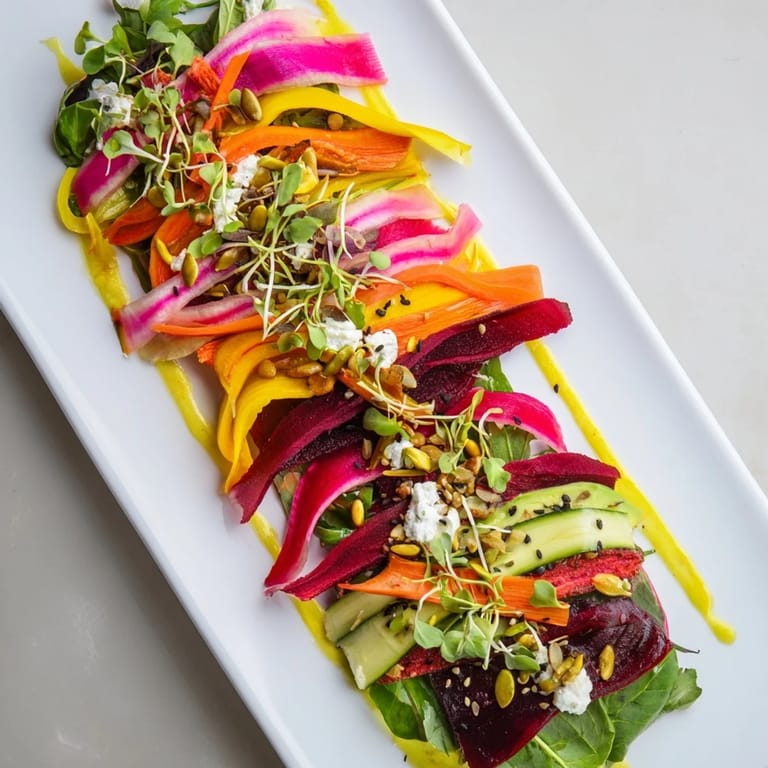
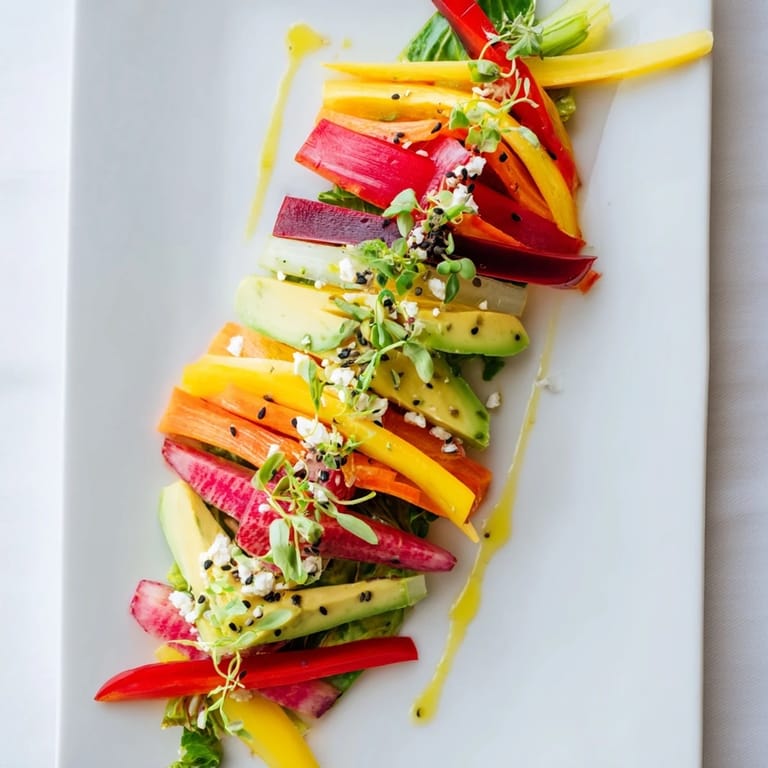
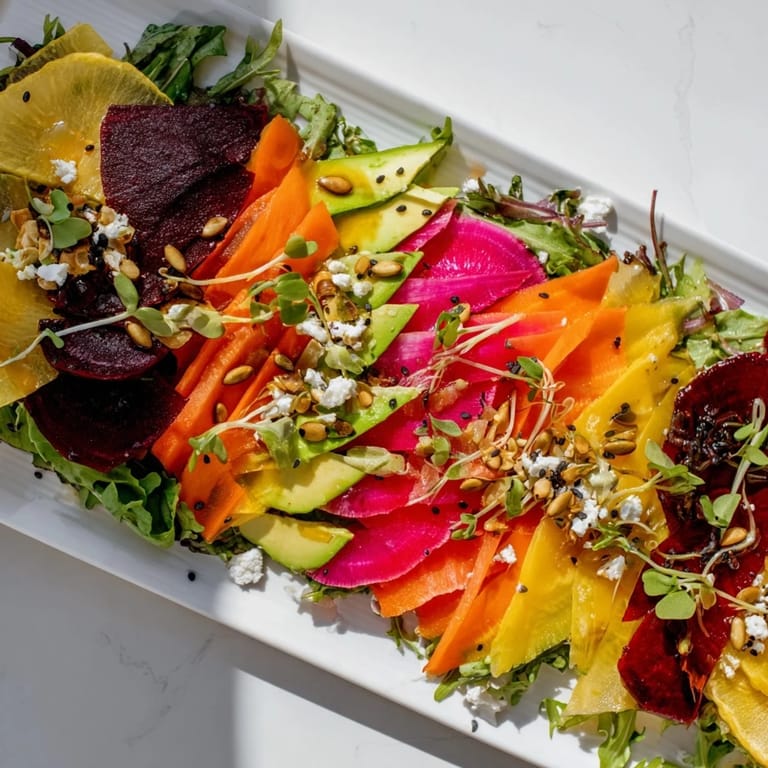
- Picture that lightning bolt. Now trust yourself to create it. Start with one color—I usually begin with the purple beets because their drama commands attention. Lay a line of thin slices diagonally across the platter, slightly overlapping each slice so you see a continuous stripe, not individual pieces. Then switch colors. Add golden beets, but create a small jag—change direction slightly, almost like you're making a sharp angle. This is what makes it a lightning strike, not just a line. Continue alternating: watermelon radish (watch how its stripes align with the zig-zag), cucumber, red pepper, yellow pepper, carrot, avocado. Each transition should be a color shock. Step back frequently. Does it feel electric? Does your eye get pulled along the strike? If not, adjust. This isn't precise—it's intuitive. Trust the colors to guide you.
- Layer on texture and flavor:
- Now scatter your feta crumbles along the zig-zag, letting them settle into the little valleys where slices meet. Sprinkle your toasted pumpkin seeds generously—they should be visible, adding flecks of olive green and cream. Then a finer scatter of black sesame seeds, which look impossibly elegant. Finally, tuck microgreens into the bends and peaks of your lightning bolt. They should look like they're growing from the arrangement, not just sitting on top.
- Make the vinaigrette:
- In a jar with a tight lid or a small bowl, combine your olive oil, lemon juice, mustard, salt, and pepper. Close that jar and shake it hard for about 20 seconds. You want it emulsified—glossy, slightly thickened, almost creamy-looking. Taste a drop on your finger. It should be bright and tangy with just enough salt to make you want more. If it's too sharp, add a splash more oil. If it's too muted, squeeze more lemon. This is your moment to season it exactly how you want it.
- Serve with drama:
- Just before guests arrive, drizzle the vinaigrette in a thin, intentional stream directly along your lightning strike. Don't drown it—the vegetables should glisten, not swim. Pour some vinaigrette into a small pitcher and let people add more if they'd like. Then bring it to the table, step back, and watch people's faces light up. Serve immediately while everything is still crisp and alive.
 Save
Save I remember making this salad on a day when someone I cared about was struggling, and they came to dinner not expecting much of anything. But when they saw the platter—that bold zig-zag of color, the way the light hit the wet vegetables, the promise of brightness—something shifted. Food can't fix hard things, but it can say: I see you, I'm glad you're here, let's share something beautiful. That's what this salad became that night.
Choosing Your Vegetables with Purpose
The magic of this salad lives in the contrast—not just color contrast, but flavor and texture contrast too. When you're at the market, look for vegetables with personality. Are your beets truly different colors? Is your radish cut open to show those stunning interior rings? Pick peppers with thick walls, not thin, flimsy ones. Your English cucumber should be firm, not soft. And avocados—press gently. You want one that yields just slightly, not rock-hard and not bruised. This salad forgives nothing because everything is raw and visible. Every vegetable you choose shows up in the final dish, so choose with care.
The Zig-Zag Arrangement: Making It Feel Natural
The zig-zag doesn't need to be perfect geometrically—it needs to feel confident. I used to overthink this, measuring angles and obsessing over symmetry, until I realized the best zig-zags are the ones where you can feel the intention behind them. The arrangement should look like lightning because lightning is jagged, assertive, and alive—not because it's mathematically precise. Some of the most beautiful composed salads I've seen have slight asymmetry. One side might be a little bolder than the other, and that's what makes it feel like you arranged it, not a computer. Trust your eye more than your ruler.
Why This Salad Works as a Meal, Not Just a Side
Composed salads have a stigma—that they're delicate, wimpy, something to pick at before the real food arrives. But this one refuses that narrative. The combination of creamy avocado, salty cheese, crispy seeds, and the substantial sweetness of roasted pumpkin seeds makes it genuinely satisfying. Pair it with some good bread and maybe a simple protein if you want, but honestly, this salad stands alone. I've served it as the main course at dinner parties, and no one felt like they were missing something. The complexity of flavors and textures is enough.
- If you want to make it heartier, add a soft cheese like goat cheese instead of feta, or toss in some toasted nuts like walnuts or pecans.
- For a vegan version, skip the feta and add extra seeds or toasted chickpeas for protein and crunch.
- This salad is best served the moment you finish dressing it—don't make it hours ahead or it will lose its snap.
 Save
Save This salad is a love letter to the idea that vegetables deserve to be celebrated, not hidden. Every time you make it, you'll find your own way of arranging the zig-zag, your own balance of flavors. That's how recipes should work—as a starting point for your own kitchen intuition.
Recipe FAQs
- → What is the best way to slice the vegetables?
Using a mandoline or a sharp chef’s knife, slice the beets, radish, cucumber, and peppers thinly and evenly (around 1-2mm) to ensure crisp texture and an attractive presentation.
- → How can I keep the avocado from browning?
Slice the avocado just before arranging, and lightly drizzle with lemon juice to maintain its vibrant color and prevent browning.
- → Can I make this dish vegan-friendly?
Yes, by omitting the feta cheese or substituting with a vegan alternative, this dish remains fresh and flavorful while accommodating vegan diets.
- → What kind of plate works best for serving?
A large rectangular or oval platter works well to showcase the sharp, zig-zag arrangement and allow the vivid layers to stand out.
- → How should the lemon vinaigrette be prepared?
Whisk extra virgin olive oil, fresh lemon juice, Dijon mustard, sea salt, and black pepper until emulsified and slightly thickened for a bright, balanced dressing.
- → How do I maintain crispness if preparing ahead?
Store sliced vegetables separately in airtight containers and assemble just before serving to retain texture and freshness.