 Save
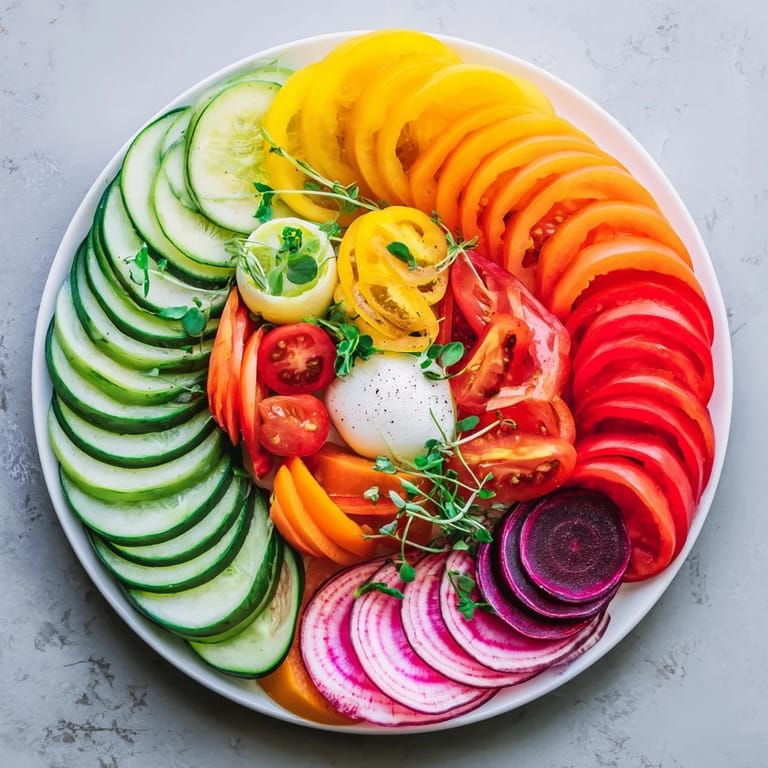
Save I'll never forget the first time I encountered a radial symmetry sunburst platter at a friend's summer gathering. The way she'd arranged all those jewel-toned vegetables in perfect concentric rings around creamy burrata caught everyone's breath before we even tasted it. That afternoon, I realized that some of the most memorable meals aren't just about flavor—they're about the moment when beauty and nourishment converge on a single plate. Now, this is my go-to recipe whenever I want to create that same sense of wonder.
I remember making this for my sister's engagement dinner last spring. As she walked into the dining room and saw that sunburst, her eyes went wide—and suddenly everyone at the table felt like they were part of something special. That's when I understood: this platter isn't just food; it's a conversation starter, a moment of pause before the feast begins, a way of saying 'you matter enough for me to arrange these vegetables with intention.'
Ingredients
- 1 small seedless cucumber: Its mild flavor and cool, crisp texture provide a refreshing base for the composition. Slice thin enough to catch the light.
- 1 small yellow squash: The pale yellow acts as a gentle transition between colors and brings subtle sweetness. Choose one without blemishes for maximum visual appeal.
- 1 medium watermelon radish: This is your star ingredient—those pink and white concentric rings are pure magic when sliced thin. Plan around its natural beauty.
- 1 ripe avocado: Slice it last, just before arranging, and toss gently with a squeeze of lemon juice to prevent browning. Its creamy texture contrasts beautifully with crisp vegetables.
- 1 medium carrot: Peeled carrots slice more smoothly on a mandoline. The orange provides warmth and visual balance to cooler tones.
- 6–8 cherry tomatoes (assorted colors): Red, yellow, and orange varieties work together to punctuate the design with pops of intensity. Halving them keeps them from rolling.
- 1 red bell pepper: Slice into thin rings for an elegant look. The shape naturally complements the radial pattern.
- 1 small purple daikon or regular daikon radish: The purple variety is visually stunning; regular white is equally delicious and mild. Peeling prevents any bitter skin notes.
- 1 small ball burrata cheese (about 100g) or ½ cup hummus: This is your center—your focal point. Burrata's creamy center is luxurious; hummus works beautifully for vegan tables and anchors the vegetables differently.
- 2 tbsp extra-virgin olive oil: Good quality oil matters here because it's tasted raw. The fruitiness enhances the fresh vegetables.
- 1 tsp flaky sea salt: Sea salt crystals are large enough to taste individually and catch light on the finished platter. They're worth seeking out for this specific use.
- ½ tsp freshly cracked black pepper: Crack it yourself for the boldest flavor and most visually appealing texture.
- Zest of 1 lemon: The bright yellow adds a visual pop and brings citrus brightness without moisture from juice.
- 2 tbsp microgreens or fresh herbs (basil, dill, or chervil): These are your final flourish. Basil feels Italian and warm; dill feels refined; chervil feels French. Choose what your heart desires. Microgreens add delicate texture and visual intrigue.
- Optional: 1 tsp toasted sesame seeds or crushed pistachios: Toasted seeds add nutty flavor and subtle crunch. Pistachios bring color and a different kind of richness. Only add if you're serving those without allergies.
Tired of Takeout? 🥡
Get 10 meals you can make faster than delivery arrives. Seriously.
One email. No spam. Unsubscribe anytime.
Instructions
- Wash and prepare all your produce with intention:
- Before you begin, wash every vegetable and fruit under cool running water, then dry each piece thoroughly on a clean kitchen towel. Pat the watermelon radish especially dry—it's the star, and any moisture dulls its jewel tones. Peel the carrot and daikon radish with a vegetable peeler, using long, confident strokes. Remove the stems from cherry tomatoes and destem the bell pepper. As you work, you'll notice which pieces feel vibrant and which might have soft spots—trim those away. This prep work is meditative; you're already creating the dish in your mind as your hands move.
- Achieve perfect uniformity with your slices:
- This is where patience transforms good into stunning. If you have a mandoline slicer, now is the time to use it—the blade does what no knife can quite match, delivering those translucent, gossamer slices. If using a chef's knife instead, grip the vegetable firmly with the claw hand and let the knife do the work, pulling toward you in smooth motions. Aim for 2–3 mm thickness throughout. The watermelon radish, cucumber, yellow squash, carrot, and daikon should all be sliced into rounds. Cut the avocado in half, remove the pit gently with a spoon, then slice each half into thin, even segments. Halve the cherry tomatoes and slice the bell pepper into rings. As each slice falls, glance at it—are the edges clean? Is the thickness consistent? This is where the magic begins to build.
- Choose and prepare your stage:
- Select your largest, flattest, most beautiful round platter—ideally at least 12 inches in diameter. A smooth white, black, or neutral ceramic platter lets the vegetables be the stars, though glass can work in a pinch. Dry the surface completely with a clean kitchen towel; any moisture causes vegetables to slip during arrangement. You might even set the platter in a cool spot for a few minutes to chill it, which helps keep your vegetables fresh as you work.
- Place your centerpiece with precision:
- Remove your burrata from the refrigerator just moments before placing it in the exact center of the platter. If using hummus, scoop it into a small mound with the back of a spoon. The center should be stable—if the burrata feels too soft, it may have been left at room temperature too long; return it to cool briefly. Some people use a ruler or even lightly mark the center with a damp paper towel to ensure perfection. The centerpiece is your sun; everything else radiates outward from this single point.
- Build your sunburst one ray at a time:
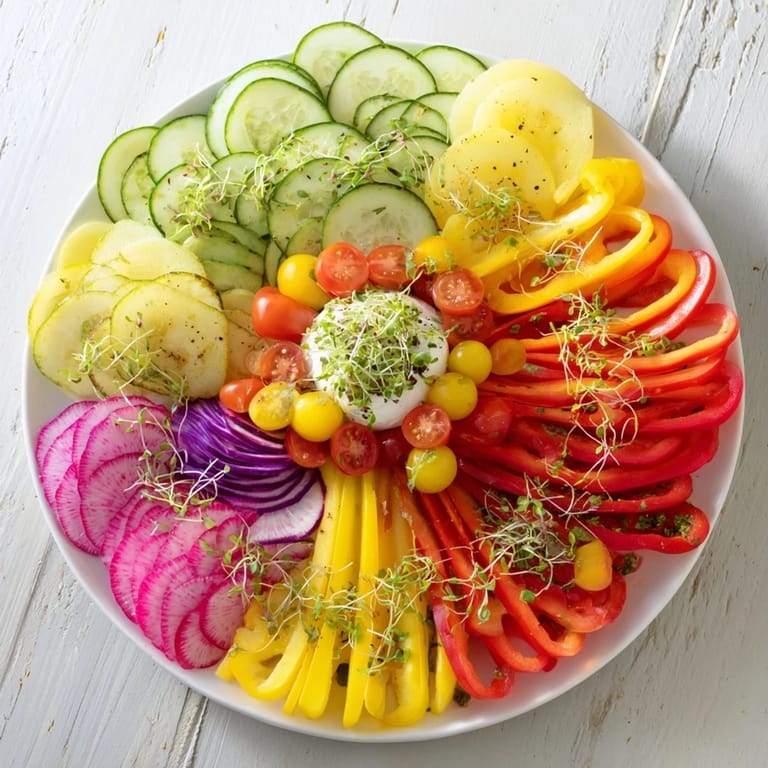
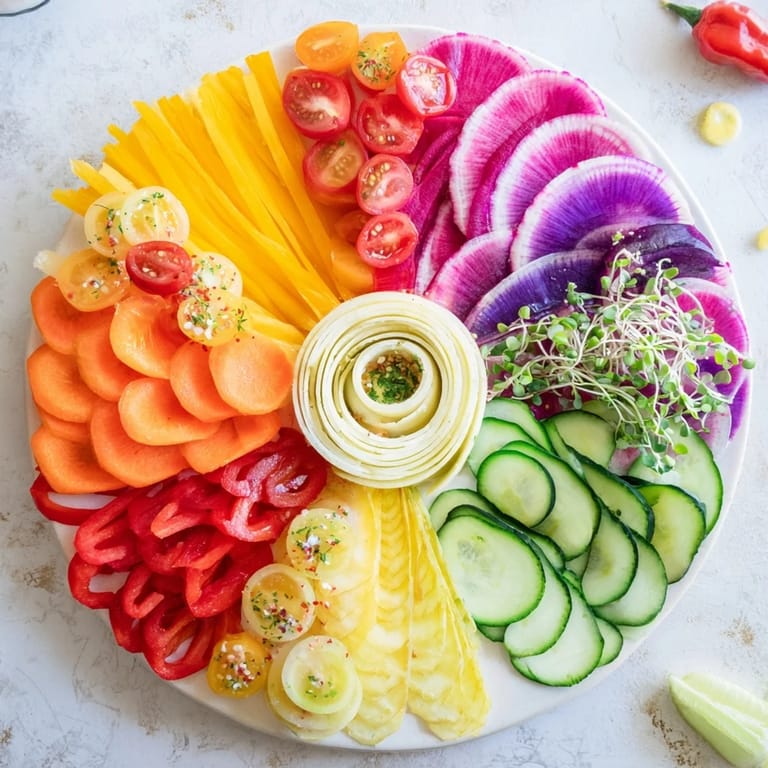
- Start with one ingredient—cucumber is a great starting point because it's neutral and forgiving. Fan the first slice outward from the center, then overlap the next slice slightly, creating a petal or ray effect that extends toward the edge of the platter. Work methodically, one ingredient per ray, alternating colors and textures as you move around the platter. Cucumber, then yellow squash, then watermelon radish, then carrot, then daikon—or arrange in whatever order your eye tells you creates harmony. Work in concentric rings if you prefer, or let each 'ray' extend from center to edge. The key is stepping back frequently to assess the overall pattern. Are the rays evenly spaced? Do opposite rays mirror each other? Adjust as you go; this is a living composition until the final garnish touches it.
- Tuck in accents for dimension:
- Once the primary vegetables are arranged, insert cherry tomato halves and bell pepper rings at regular intervals between the rays, like jewels between spokes of a wheel. Place avocado slices strategically, fanning them slightly for added visual interest and movement. The rule of thumb: no two similar colors should cluster together. Step back and look. If you see a pocket of all pale vegetables, insert a red tomato. If there's a zone of cool colors, warm it with carrot. This is where you let intuition take over and trust your eye.
- Finish with oil, salt, pepper, and brightness:
- Drizzle extra-virgin olive oil evenly over the entire platter—use a spoon or bottle with a pouring spout to control the flow. Include the burrata or hummus; the oil should glisten across everything. Now, carefully sprinkle flaky sea salt and freshly cracked black pepper over the vegetables, distributing them so no area is overlooked. Scatter the lemon zest—those bright yellow flecks act as finishing jewels. Finally, top with microgreens or fresh herbs and, if desired, sesame seeds or crushed pistachios. Your platter should now have depth, fragrance, and that professional polish that makes people pause before eating.
- Serve at the peak of freshness:
- Bring the platter to the table immediately. Encourage your guests to take a moment and truly look at it before the first plate is filled. The vegetables are at their crispest now, and that's the moment you want to capture. If plating family-style, remind people that they can choose their own colors and combinations, making each bite a small act of creation.
 Save
Save There's a moment, maybe 10 minutes into arrangement when the pattern begins to emerge and you realize you've created something that exists in that rare space between art and sustenance. That's when this recipe stops being about vegetables and becomes about the conversation it starts, the photos people take, the memory they carry home with them.
The Philosophy of Visual Eating
Food scientists tell us that flavor is 90% visual and olfactory—we taste with our eyes first. This platter leans into that truth completely. When you arrange vegetables with this much intention, you're not just feeding people; you're honoring the ingredients and creating a moment of pause in a world that rarely pauses. The symmetry speaks to something in our brains that finds order beautiful. You're tapping into that. Sometimes the simplest dishes—no cooking required, just attention to detail—become the most memorable because they ask something of us as cooks: to see vegetables as they truly are.
Navigating Ingredient Swaps with Confidence
This platter thrives on fresh seasonal produce, so please let the seasons guide your choices. In autumn, add thinly sliced beets (roast them briefly to set their color, then cool before slicing), rainbow carrots, and perhaps fennel. In winter, try thinly shaved radishes in multiple varieties, sliced celeriac, and mandoline-thin pear slices (toss in lemon juice immediately). Spring calls for thinly sliced sugar snap peas, baby radishes halved lengthwise, and young zucchini. The structure remains the same; only the players change. For the center, if burrata isn't available, whipped goat cheese, labneh, hummus, or even a generous dollop of tzatziki works beautifully. The key is something creamy and rich enough to anchor the crisp vegetables around it. Vegan diners will love a high-quality hummus or cashew cream centered in that spot.
Timing, Storage, and the Art of Freshness
This platter is a time-sensitive creation in the best possible way. It's designed to be made and served within an hour, when vegetables are at their peak. If you must prepare ahead, wash and slice all vegetables, store them separately in airtight containers with paper towels to absorb excess moisture, and chill for up to 4 hours. Assemble within 30 minutes of serving. Once dressed with oil and salt, vegetables begin to soften—don't do this more than 15 minutes before service. If you find yourself with leftovers (rare, but it happens), cover the platter tightly and refrigerate for up to 4 hours, but understand that crispness fades quickly and the arrangement may shift. Freezing destroys the texture entirely, so don't attempt it. This is a recipe that asks you to be present and to cook for the moment rather than for convenience.
- Use a ruler or marked template when establishing your center if symmetry is your obsession—it's worth the extra minute.
- Chill your platter in the refrigerator for 10 minutes before assembly; cool dishes keep vegetables fresh longer and look more elegant.
- Taste a tiny slice of each vegetable as you work; you're checking for quality and getting to know what you're plating.
 Save
Save This platter isn't complicated, but it is intentional. Make it when you want to say 'you matter' without words.
Recipe FAQs
- → How do I achieve perfect radial symmetry when arranging vegetables?
Use a ruler or template to mark the center of your platter. Slice ingredients uniformly with a mandoline or sharp knife and fan each vegetable in neat concentric circles to maintain balance and visual harmony.
- → Can I substitute the burrata for a dairy-free option?
Yes, vegan cheese, labneh, or classic hummus work well as creamy alternatives, maintaining the central focal point with similar texture and appearance.
- → What is the best way to keep vegetables crisp before serving?
Chill the serving platter prior to assembly and ensure all produce is thoroughly washed and dried. Prepare just before serving to maintain freshness and avoid wilting.
- → What tools are recommended for preparing the slices?
A mandoline slicer is preferred for thin, even rounds, but a sharp chef’s knife and vegetable peeler can also achieve precise cuts necessary for uniform layering.
- → How should I store leftovers if any remain?
Cover tightly and refrigerate for up to 4 hours. Avoid storing after oil and salt have been applied to prevent the vegetables from softening. Do not freeze.